Mowgli obtains the Red Flower
The Jungle BookMowgli obtains the Red Flower at Bagheera’s urging, and the act becomes the decisive preparation for the crisis at the Council Rock. The Red Flower is fire, feared by every jungle creature, but Mowgli learns to handle it without fear: by taking a fire-pot from a human child, feeding its coals, and tending it patiently, he turns knowledge inherited from human memory into a source of authority in the wolf world.
The Threat Behind the Quest
Bagheera’s advice arises from a mounting danger within the Seeonee Wolf Pack. The Law of the Jungle requires wolf cubs to be presented before the Pack Council at the full moon; after inspection, they are protected from being killed by adult wolves until they have taken their first buck. This rule has enabled Mowgli to remain among the wolves, but it cannot erase the difference that the Pack increasingly sees in him. Bagheera warns that Mowgli’s carelessness has revealed that he is a man, and that the wolves who hate him cannot meet his eyes because he is wise, useful, and unmistakably human.
The immediate political danger concerns Akela. Bagheera anticipates that when Akela misses his next kill, the Pack will turn against both its aging leader and Mowgli. The forecast becomes reality: Akela’s weakness is exposed through a deliberately arranged hunt, and the Pack gathers at the Council Rock while Shere Khan’s supporters openly seek a change of leadership. Akela declares that, under the Law of the Jungle, the Pack has the right to kill him after his failed kill, but no wolf is willing to fight him. Shere Khan instead shifts the accusation toward Mowgli, demanding that the “man-cub” be surrendered because he is human and has long troubled the jungle.
Learning What the Red Flower Is
The name Red Flower conceals fire because jungle creatures will not call fire by its proper name. Every beast fears it and invents other descriptions for it, so the phrase carries both practical and symbolic force: it is a natural object treated as forbidden knowledge, and it is also the power associated with human beings. Bagheera tells Mowgli that it grows in little pots outside the men’s huts and instructs him to take one quickly and keep it for a time of need.
Mowgli accepts the task as a test rather than as an impossible theft. He runs down toward the croplands where the villagers live and hides near a hut. Through the window, he watches a husbandman’s wife feed the hearth with black lumps. At dawn, he sees the human child fill a wicker pot, plastered inside with earth, with red-hot charcoal, place it beneath his blanket, and carry it to the cattle byre. The scene gives Mowgli a precise model of how fire is transported and maintained.
When Mowgli sees the child handling the pot, he reasons that if a human cub can carry it, there is no reason for him to fear it. He takes the pot from the boy’s hand and disappears into the mist while the child cries out. The action is direct and unsentimental: Mowgli does not ask permission, bargain, or wait for a larger plan. He observes a human practice, judges the risk, and reproduces the practice himself.
Tending the Fire
Mowgli quickly understands that possessing the fire-pot is not enough. He blows into it as he has seen the woman do and recognizes that the fire will die unless it is fed. He therefore adds twigs and dried bark to the embers while carrying the pot back toward the hill. The object becomes a living responsibility in miniature, requiring attention, fuel, and repeated observation rather than mere possession.
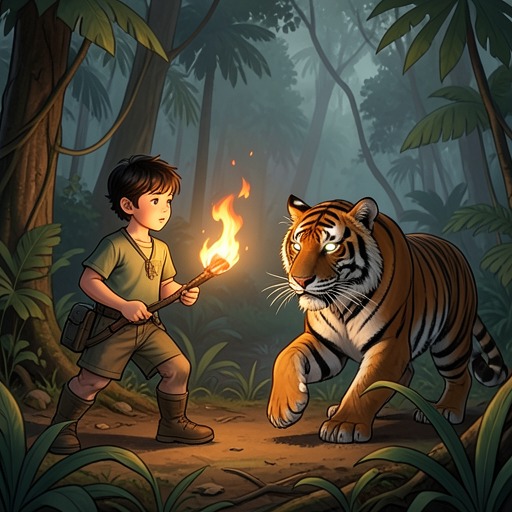
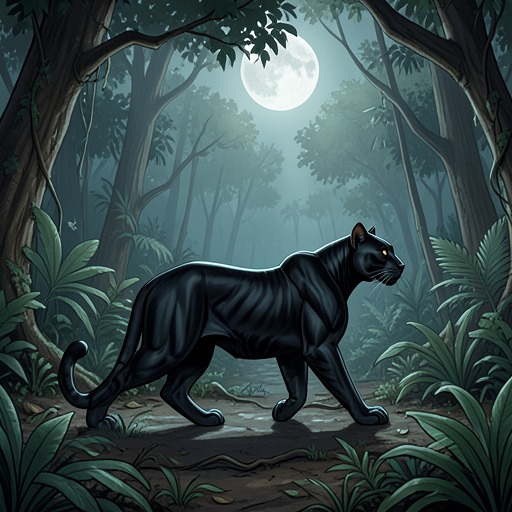
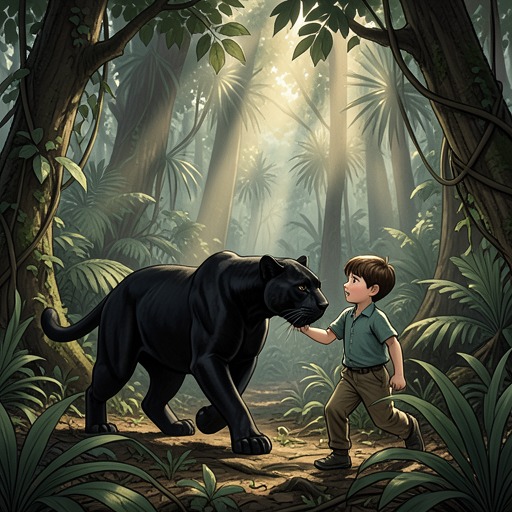
On the way, Mowgli meets Bagheera, whose coat shines with morning dew. Bagheera reports that Akela has missed his kill and that the wolves had already intended to kill him, although they also needed Mowgli and had searched for him on the hill. Mowgli answers by displaying the fire-pot and declaring that he is ready. Bagheera explains another technique he has observed among humans: a dry branch thrust into the fire will soon bear the Red Flower at its end. Mowgli remains unafraid because he recalls, perhaps only as a dream, lying beside the Red Flower before he became a wolf and finding it warm and pleasant.
Mowgli spends the entire day in the cave tending the pot. He dips dry branches into it one after another until he finds one that satisfies him. This rehearsal matters because it changes the act from a lucky acquisition into controlled preparation. By evening, when Tabaqui arrives to say rudely that Mowgli is wanted at the Council Rock, Mowgli laughs so freely that Tabaqui runs away. He then goes to the Council carrying the fire-pot between his knees.
Fire at the Council Rock
The Council scene reverses the balance of power established by the Pack’s customary inspection. The cubs once stood in the center while the adult wolves examined them under the full moon; now Akela lies beside his rock as a sign that leadership is open, and Shere Khan moves openly among the wolves while receiving flattery. The Pack’s law has become an instrument in a succession struggle, and Mowgli’s status is being redefined from protected cub to condemned outsider.
The wolves shout that Mowgli has no right to speak, while others insist that he has kept their Law. The seniors finally call for Akela, the “Dead Wolf,” a title imposed on a leader who has missed his kill. Akela acknowledges the formal right of the Pack to end his life and challenges any wolf to come against him one by one. The silence that follows exposes the difference between legal permission and actual courage: the Pack can pronounce a sentence, but none of its members wants to execute it.
Shere Khan fills that silence with a demand for Mowgli. More than half the Pack begins to echo the claim that Mowgli is a man and therefore has no place among them. Against this collective pressure, the fire-pot provides a form of power the wolves cannot easily absorb into their customary rules. It is not merely a weapon; it is evidence that Mowgli possesses the human capacity that separates him from the Pack and can use that difference on his own terms.
Significance of the Action
Mowgli’s obtaining of the Red Flower marks a threshold between dependence and self-directed power. He has been protected by Raksha, Father Wolf, Bagheera, Baloo, and the Pack’s law, but Bagheera’s warning makes clear that these protections are weakening. Fire gives Mowgli a stronger immediate ally than any single wolf can provide, because every jungle animal fears it and none can safely dismiss it as a human weakness.
The act also reveals the unstable coexistence of different systems of order. The wolves rely on the Law of the Jungle and the procedures of the Council; the villagers rely on household knowledge passed through ordinary practice; Mowgli crosses between those worlds by watching, taking, testing, and adapting. In the broader book, the same pattern appears in the beach rules governing Sea Catch, the Indian Government’s preservation and capture of elephants, and the chain of command by which an order is obeyed from driver through military ranks. Rules organize each community, but power depends on who can interpret, enforce, or move between them.
Most importantly, the Red Flower changes the value at stake in the Council scene. Before Mowgli acquires it, the threat is directed at him: the Pack may expel or kill him, and Shere Khan seeks to claim him. After he acquires and tends it, Mowgli enters the confrontation prepared, carrying the feared sign of human power into the center of the wolf assembly. The fire does not make him a wolf; it makes his human identity impossible to suppress, and it gives that identity the force to answer the Pack’s rejection.